Enable Access for Assistive Devices and Try Again
 Assistive Devices and Assistive Apps are applications and accessories which can command parts of the Mac and MacOS beyond the normal scope of app limits. While information technology's primarily thought of as an Accessibility characteristic, it's also unremarkably uses for general apps too, ranging from screen sharing functions, to apps that require microphone admission, to fifty-fifty spider web browsers and many popular games. Because of it's widespread usage
many users may demand to enable assistive devices and apps, only what was once called "Assistive Devices" and controlled within the Universal Access / Accessibility control panel has since moved to a new generalized location in MacOS.
Let's see how to enable it in the latest version of Mac Bone X, and besides how to control and modify what apps tin can use the Assistive Device features.
How to Enable Assistive Devices & Assistive App Back up in Mac OS
- Open up System Preferences from the Apple carte and become to the "Security & Privacy" panel
- Choose the "Privacy" tab
- Select "Accessibility" from the left side menu options
- Click the lock icon in the lower left corner and enter an administrator password to gain access to the apps with assistive privileges
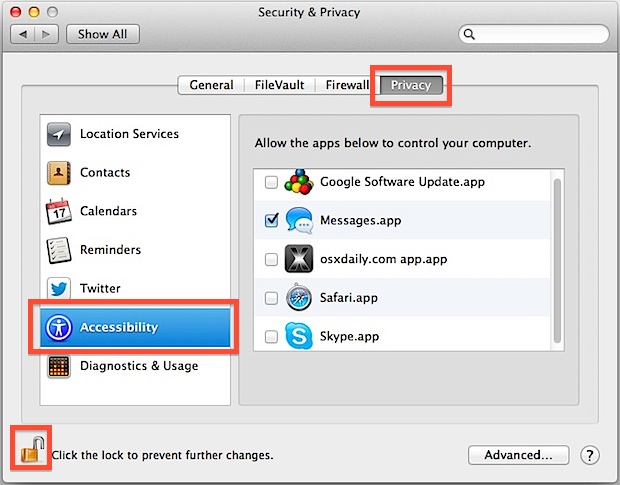
(Note that older versions of Mac Bone X can find this setting in Organization Preferences > Universal Access > checking "Enable access for assistive devices")
The listing displayed shows exactly what apps can control the Mac using the Assistive Devices feature set. As mentioned above, this may include access to the photographic camera, microphone, screen, keyboard, or other such functions of a Mac. If you see something in this listing you do not want to have such admission, or yous don't see an app you do want to have assistive admission, you lot can easily command both, which we'll cover next.
How to Command What Apps Accept Assistive Access in Mac OS X
Nearly applications that want access to the Assistive Device panel will request permission upon first launch. This arrives in the form of a pop-upwardly dialog box with a message saying "Appname would like to control this figurer using accessibility features." with an option to "Deny" the request. Note that if you deny the app, you can add together it again later or toggle the setting hands by going to the Privacy command panel.
Allow's focus on controlling what apps take or exercise not accept assistive accessibility functions on the Mac by using the Privacy > Accessibility command panel. This is washed hands:
- Add a new app to Assistive Devices command by dragging and dropping the awarding into the window, typically from the Finder /Applications folder
- Revoke Assistive Device access for whatever awarding in the list past unchecking the box alongside the respective awarding name
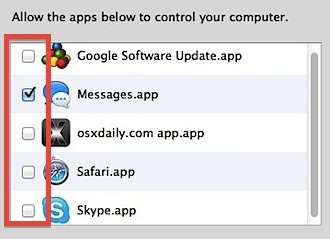
Yous may discover some apps in the accessibility list that you did not expect to come across here, and if you lot meet something curious consider the features of the app that may request more control over the Mac in order to office. For example, many pop games will require admission to the Assistive Devices abilities so that an online game can properly employ voice conversation or screen broadcasting. This is true with nearly all Steam games, ranging from Team Fortress ii to Civilization V, and Blizzard / Battle Net games like StarCraft two and Globe of Warcraft. Note these games volition proceed to function without Assistive Admission, but their feature ready for online communication and sharing may be express, and thus if yous're playing games and notice the voice conversation features aren't working, this setting or app-specific access could very well be the reason why. The same commonly applies to other apps as well, and similar fine-tuned control is now bachelor to iOS devices as well for apps attempting to access everything from location information to the microphone and camera.
If you lot're wondering why this feature is at present in the "Privacy" command panel, it'south likely a more appropriate identify considering the heightened abilities such apps and devices can take access to on a Mac. Additionally, becacuse the feature has wider spread usage beyond general universal access functionalities, it makes sense to augment its controls to more than generalized privacy preferences.
This change get-go appeared in Mac Os X Mavericks and persists today in MacOS Mojave, Catalina, Yosemite, El Capitan, High Sierra, Sierra, and presumably onward.
Source: https://osxdaily.com/2014/01/05/enable-access-assistive-devices-apps-mac-os-x/
0 Response to "Enable Access for Assistive Devices and Try Again"
Post a Comment